
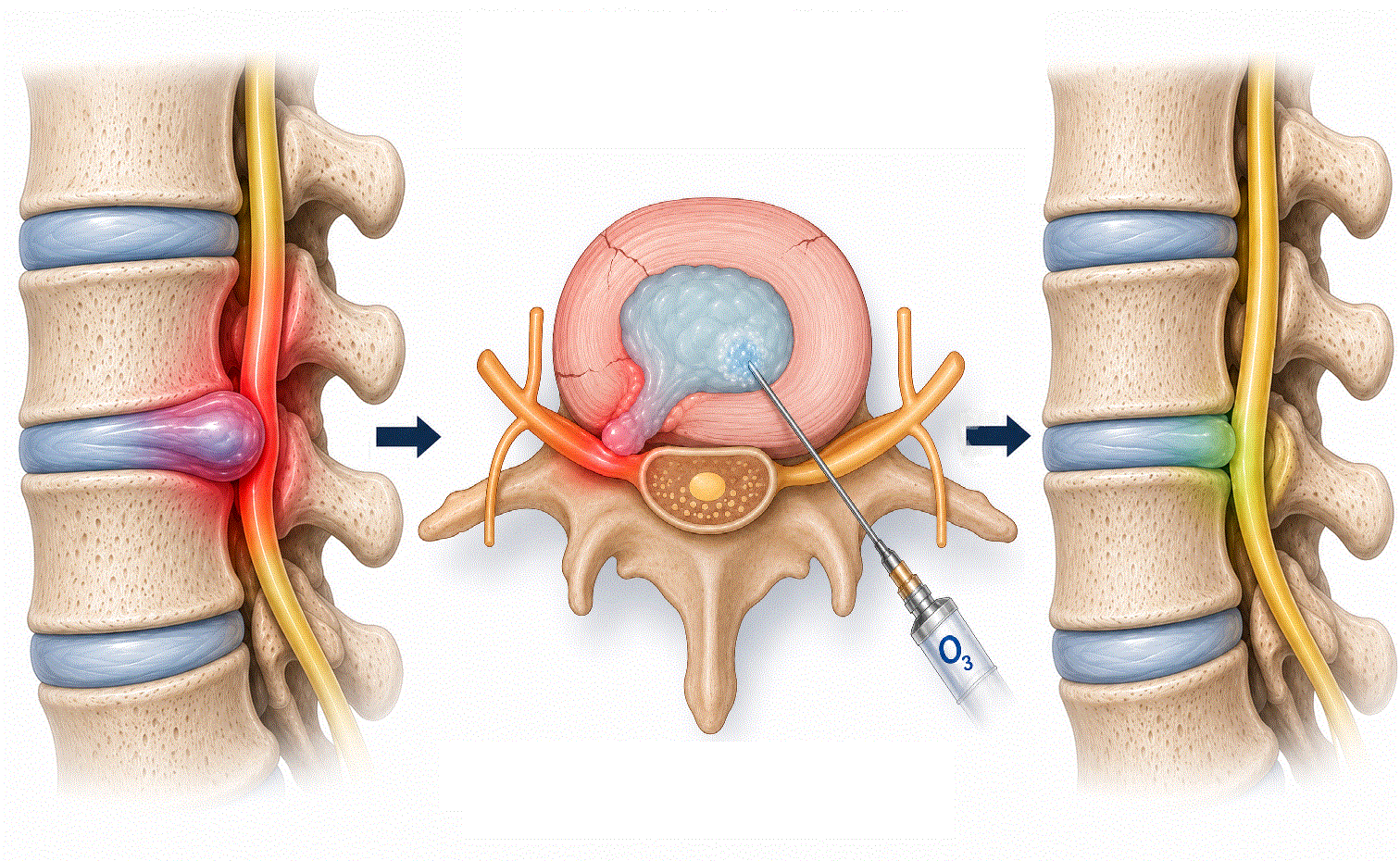
Patients ask about intradiscal ozone. Usually they’ve seen it on an overseas clinic’s website, or come across it in a research summary, and they want to know where it stands here.
The honest answer takes a sentence more than most people expect. Medical ozone has no market authorization in Canada — it is not an approved therapy and cannot be offered as a routine one. Health Canada does operate a Special Access Programme, through which a physician may request access to a non-marketed drug for an individual patient when conventional treatments have failed or are unsuitable. That is a patient-by-patient mechanism, decided case by case, and access under it is not an endorsement of the treatment.
This article isn’t an offer of ozone therapy. It’s an explanation of what the procedure is, what the research does and doesn’t establish, and why the regulatory position sits where it does.
What is it?
Intradiscal ozone therapy is a needle-based, image-guided procedure. Using X-ray (fluoroscopic) guidance, a physician places a fine needle into the affected disc and injects a small, precisely measured amount of a medical oxygen-ozone gas mixture. It’s typically done as a day procedure, without general anaesthetic, and most people go home the same day.
How does it work?
A healthy disc holds a lot of water, which keeps it plump and under pressure. When a disc bulges or herniates, that pressure can push on a nearby nerve and cause pain radiating into the leg (sciatica).
The oxygen-ozone mixture is thought to work in a few complementary ways:
- Gently shrinking the disc. Ozone reacts with the water-holding molecules within the disc, causing it to dehydrate and shrink slightly. Even a small reduction can meaningfully lower the pressure on the nerve.
- Calming inflammation around the irritated nerve root.
- Easing pain and improving local circulation to the compressed nerve.
Because the effect is gentle and self-limited, the disc is not removed or destroyed – which means other treatment options, including surgery, remain open afterward.
What does the research show?
Intradiscal ozone has been studied and used in Europe for over two decades, with a growing body of evidence:
- Large clinical series report meaningful pain relief in roughly 70-80% of carefully selected patients.
- Two well-designed randomized trials published in 2021 found intradiscal ozone to be comparable to surgery (microdiscectomy for six-month leg-pain improvement, and that a majority of patients who received ozone were able to avoid surgery, with faster recovery and lower cost.
It’s worth striking a balance: much of the older evidence comes from specialized centres, and researchers agree that larger, more rigorous trials are still needed. Ozone therapy is “not a cure-all”, and results vary from person to person.
Who might it help and who is it not for?
It tends to work best for people with a contained disc herniation or bulge (where the disc’s outer layer is still intact) causing single-level nerve pain that hasn’t responded to several weeks of conservative care.
It is generally not suitable when there is a large, fragmented (sequestered) or calcified herniation, significant spinal-canal narrowing, or certain other conditions. Sudden severe weakness, loss of bladder or bowel control, or saddle numbness are medical emergencies and require urgent assessment, not this procedure.
Determining candidacy requires a proper clinical assessment and review of your MRI.
Is it safe?
Reported complication rates in the published series are low, but those series are small, come from a limited number of specialised centres, and were not designed to detect uncommon adverse events. Low reported harm in a small literature is not the same as established safety, and this is one of the areas where the absence of large trials matters most.
The risks inherent to any spinal injection apply — infection, bleeding, and injection-related complications — which is why procedures of this kind are performed under strict sterile conditions by an experienced physician.
Thinking about your options?
The research concerns contained lumbar disc herniation — where the outer layer of the disc remains intact — producing single-level nerve pain that has not settled with conservative care.
Separately from any question of ozone: sudden severe weakness, loss of bladder or bowel control, or numbness in the saddle area are medical emergencies. If you have these, go to an emergency department today.
What actually matters if you have disc-related leg pain
Whatever you have read about, the useful first step is the same. Most people with a herniated disc improve without surgery, many herniations shrink on their own over months, and a substantial number of people with leg pain turn out not to have a disc problem at all — the pain comes from the spinal canal, a facet joint or the sacroiliac joint, which need entirely different treatment.
None of that can be sorted out from a scan report or from reading about procedures. It requires examination and direct review of your imaging by a spine specialist.
This article is for general information and is not medical advice. It describes a therapy that is not approved in Canada and is not an offer to provide it. Any treatment decision should follow individual assessment and an informed-consent discussion with a qualified physician.