
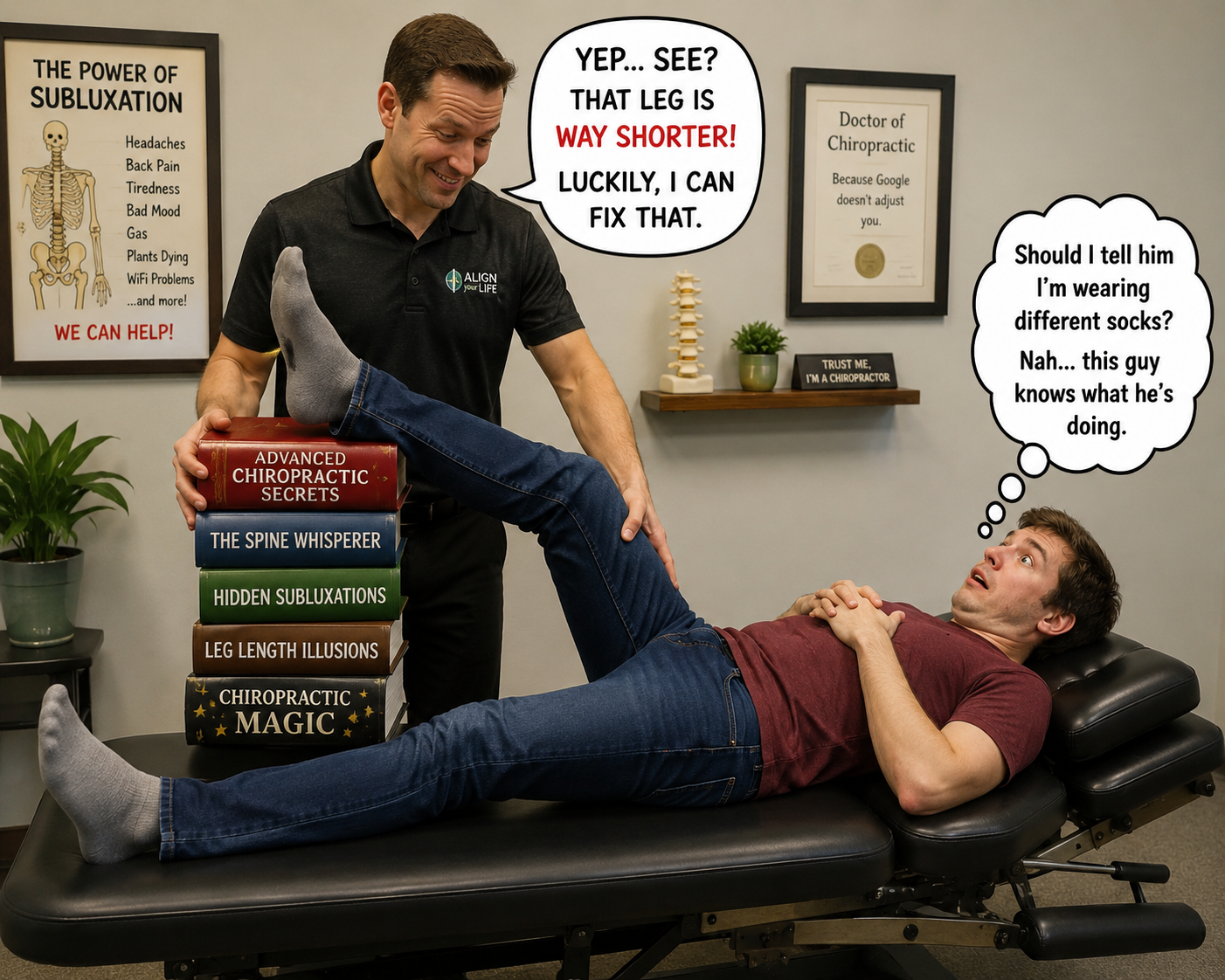
Exhibit #1: The Magical Shrinking Leg
Patient lies down.
Practitioner grabs both ankles.
One foot mysteriously appears a centimetre shorter.
Gasps fill the room.
“You see? Your pelvis is out. Luckily, I can fix it.”
What happened?
Usually… nothing.
The apparent “short leg” often changes depending on how the patient’s hips are rotated, how the ankles are held, how much pressure is applied, or simply how carefully (or creatively) the examiner positions the feet. If you repeat the test a few times, today’s “short leg” may become tomorrow’s “long leg.”
Congratulations! You’ve witnessed the healthcare equivalent of a card trick.
Exhibit #2: The Universal Subluxation
Do you have:
- Headaches?
- Back pain?
- Allergies?
- Fatigue?
- Constipation?
- Bad luck?
- Wi-Fi problems?
- A cat that ignores you?
Clearly your spine is “out.”
The beauty of an invisible diagnosis is that it never shows up on MRI, CT, X-ray, ultrasound, or reality itself.
Exhibit #3: The Rice Krispies Therapy
Snap.
Crackle.
Pop.
“Did you hear that? That’s the toxins leaving your body.”
Actually, those sounds usually come from gas bubbles in joints or tissues moving—not evil spirits abandoning your vertebrae.
Sorry.
Exhibit #4: Lifetime Maintenance Plan
Congratulations!
After one examination, you’ve somehow been diagnosed with a condition requiring:
- 3 visits per week
- for 6 weeks
- then weekly
- then monthly
- then forever.
Dentists recommend checkups because teeth accumulate plaque.
Cars need oil changes because engines wear.
Your lumbar spine does not need a subscription service.
Exhibit #5: The Miracle Adjustment
One adjustment allegedly improves:
- asthma,
- immunity,
- digestion,
- blood pressure,
- fertility,
- eyesight,
- financial planning,
- and your golf swing.
If one treatment cured that many conditions, it wouldn’t be sold in a strip mall—it would earn several Nobel Prizes.
Exhibit #6: The “Don’t Believe the MRI” MRI
When imaging is normal:
“MRIs don’t show the real problem.”
When imaging shows arthritis:
“Exactly what I expected.”
Heads I win.
Tails I also win.
Exhibit #7: The Anti-Gravity Neck Pull
Somewhere there’s still a machine that gently stretches your neck while dramatic music plays.
Will it relax some muscles temporarily?
Maybe.
Will it realign your entire skeleton and restore the flow of life energy?
Let’s just say the evidence has been remarkably shy.
So What Does Work?
Fortunately, modern pain medicine has something far less exciting than magic.
It’s called… evidence.
Depending on the condition, that may include:
- education,
- exercise,
- weight management,
- good sleep,
- physical therapy,
- medications when appropriate,
- image-guided procedures,
- and occasionally surgery.
None of these are as dramatic as declaring one leg mysteriously shorter than the other.
But they have one major advantage.
They tend to work.
The Bottom Line
Healthcare shouldn’t rely on optical illusions, mysterious energies, or diagnoses that disappear when someone else repeats the examination.
Request evidence.
Be skeptical of anyone who claims to cure everything.
And if someone tells you one leg is shorter than the other…
…try putting both socks on first..
Disclaimer: This is satire. Many chiropractors, physiotherapists, physicians, and other healthcare professionals practice evidence-based medicine. This article pokes fun at techniques and claims that are poorly supported by scientific evidence—not at any profession as a whole.