
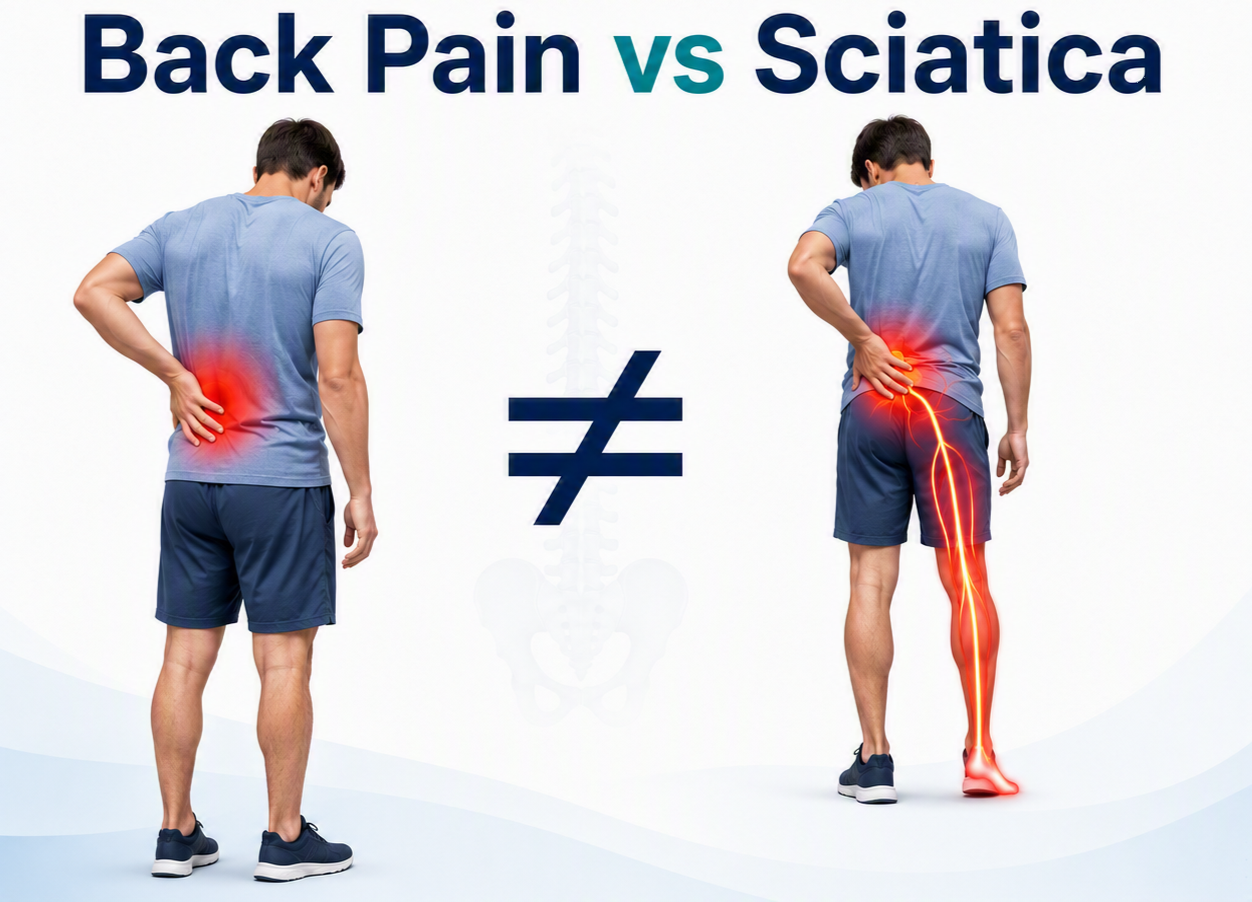
Most people use “back pain” and “sciatica” almost interchangeably — and that’s exactly where treatment plans start to go wrong. The two are not the same condition, they don’t always share the same cause, and they don’t respond to the same care. At Unika Medical Centre, every plan begins the same way: with a precise diagnosis, not a guess dressed up as a treatment.
Back Pain and Sciatica Are Not the Same Thing
“Back pain” is a symptom, not a diagnosis. It can originate from the discs, the facet joints, the sacroiliac joint, the surrounding muscles, or a combination of these — and each source responds to a different approach.
“Sciatica,” by contrast, describes a specific pattern: pain that radiates from the lower back or buttock down the leg, caused by irritation, inflammation or compression of a nerve root. A herniated disc is a common cause, but it isn’t the only one; other structural changes can produce a very similar pattern. This is exactly why the symptom alone isn’t enough to recommend the right treatment approach.
Why “Just Treating the Pain” Often Falls Short
An injection or procedure can only work as well as the diagnosis behind it. Without imaging and a clinical exam to confirm exactly which structure is causing the symptoms, treatment becomes a process of trial and error, and patients can spend months cycling through interventions aimed at the wrong target.
This is the core distinction in how Unika approaches spine and musculoskeletal care: diagnosis comes first, and every subsequent step is matched to what the diagnosis shows.
The Unika Approach: Four Stages, One Path Back to Function
Every patient moves through the same structured continuum:
- Precise Diagnosis — A detailed clinical assessment correlated with imaging to identify the actual source of symptoms, not just the location of pain.
- Targeted Intervention — When a procedure is appropriate, it is image-guided and matched directly to the confirmed diagnosis.
- Active Rehabilitation — Specialized spine physiotherapy focused on restoring movement, strength, and function — not simply reducing symptoms.
- Neurosurgical Pathway — When findings point to a structural issue that may benefit from a surgical opinion, that consultation happens under the same roof, without the delay of an external referral.
That last stage is a meaningful differentiator: Unika brings a spine specialist and a neurosurgeon together in one outpatient setting, alongside dedicated spine physiotherapy — so the diagnostic picture and the treatment pathway stay connected at every stage.
When Sciatica May Signal Something More Serious
Most episodes of back pain and sciatica are manageable and improve with the right diagnostic and treatment plan. That said, some symptoms warrant prompt medical attention, including progressive leg weakness, numbness in the saddle area, or new changes in bladder or bowel control. Anyone experiencing these should seek medical care right away rather than waiting for a scheduled appointment.
What This Means If You’re Active
For active adults, the goal isn’t just symptom relief — it’s getting back to the activity that matters to you, whether that’s golf, running, or training. A diagnosis-first approach identifies not only what’s causing the pain, but what needs to happen — through targeted treatment and structured rehabilitation — to return to full activity with confidence.
Getting Started
If you or a patient is dealing with persistent back pain or sciatica, the first step is a referral from a family physician. Ask your doctor about a referral to Unika Medical Centre for a comprehensive spine assessment.
Frequently Asked Questions
Q: Is sciatica the same as a herniated disc?
A: Not necessarily. A herniated disc is one possible cause of sciatica, but nerve root irritation can also result from spinal stenosis or other structural changes. Imaging and a clinical exam are needed to confirm the actual cause.
Q: Does back pain always require treatment?
A: Many episodes of back pain improve with time and appropriate conservative care. A proper evaluation helps determine whether further assessment or intervention is needed, and rules out less common but more serious causes.
Q: When should I see a spine specialist for sciatica?
A: If leg pain persists beyond a few weeks, is severe, or is accompanied by numbness, weakness, or changes in bladder or bowel function, a specialist evaluation is recommended. Ask your family doctor about a referral.
Q: What makes Unika’s approach different?
A: Unika combines a spine specialist and a neurosurgeon with dedicated spine physiotherapy in one outpatient setting. Every care plan starts with a precise diagnosis before any treatment is recommended.