
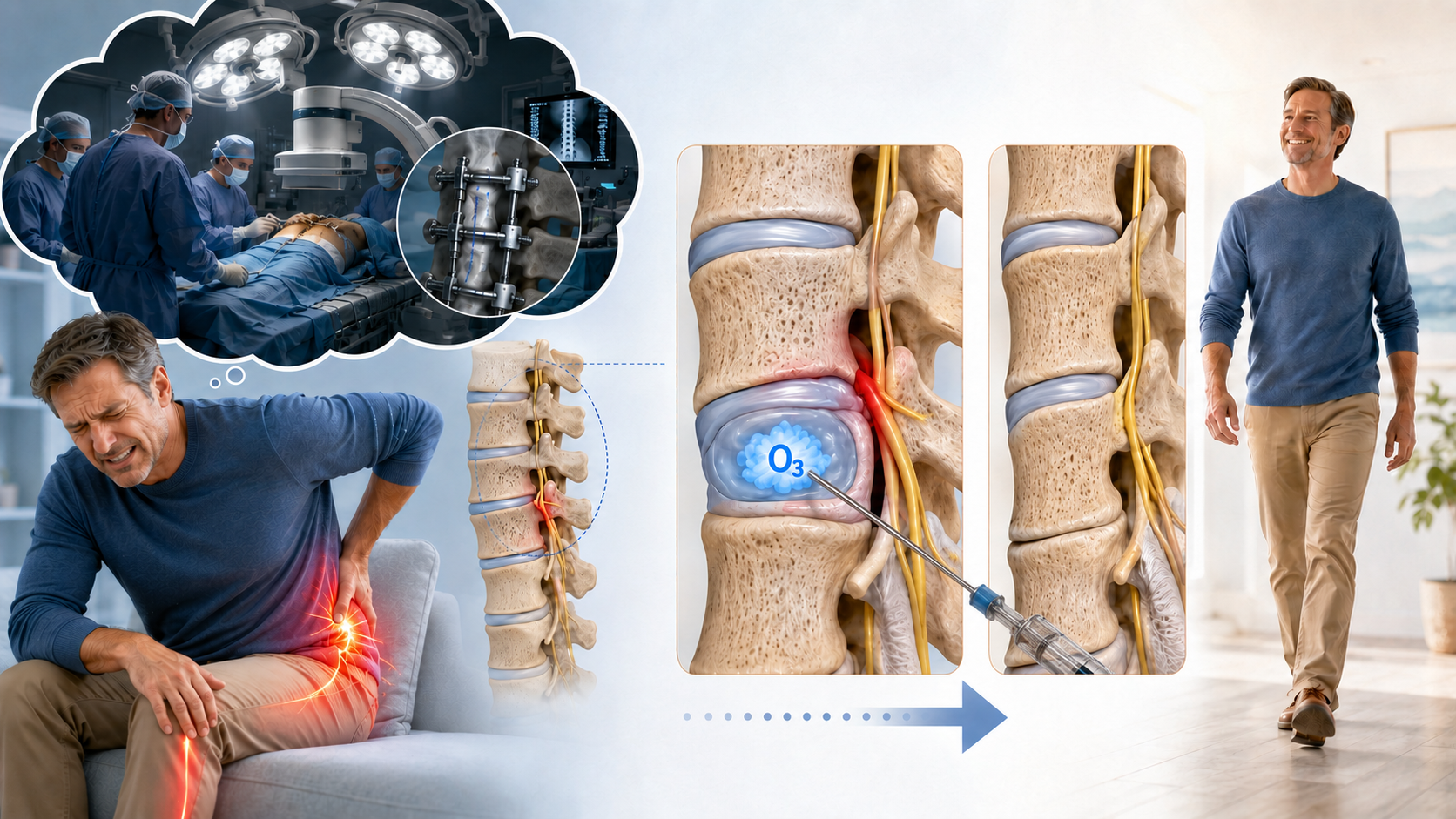
The patient story below is a composite based on cases we commonly see. It is not about one specific person.
If you’re dealing with sciatica — that sharp, burning, or shooting pain that runs from your lower back downyour leg — you already know how much it can take over your life. Sitting hurts. Walking hurts. Even lying downdoesn’t always help.
Here’s a story we hear often: a young, otherwise healthy patient developed severe sciatica from a largeherniated disc. He tried physiotherapy. He tried medication. He even had a precisely placed epidural steroidinjection, which helped for a short while before the pain returned.
Not long ago, his next step would have been surgery.
Instead, he had intradiscal ozone therapy — a simple, image-guided injection. Within weeks, his pain droppedby about 80%. That was enough for him to start rebuilding strength through a proper rehab program, withoutever needing an operation.
This article explains what ozone therapy is, how it works, and what the research says — so you can have aninformed conversation with your doctor about whether it’s right for you.
What Causes Sciatica?
Sciatica happens when a disc in your lower back — the cushion between your spinal bones — bulges orherniates and presses on a nearby nerve. That pressure, combined with inflammation around the nerve, iswhat causes the pain, tingling, numbness, or weakness that can travel down your leg.
Most people improve with rest, physiotherapy, and anti-inflammatory medication. But some don’t — and that’swhen other options come into play.
When Physiotherapy and Epidural Injections Aren’t Enough
A fluoroscopy-guided epidural steroid injection is often the next step after conservative treatment. It deliversanti-inflammatory medication right to the irritated nerve, and for many people, it works well.
But an epidural doesn’t shrink the disc itself. If a bulging disc is still physically pressing on the nerve, the paincan come back once the medication wears off. Historically, at that point, surgery was really the only remainingoption to physically relieve the pressure.
That’s the gap intradiscal ozone therapy is designed to fill.
What Is Intradiscal Ozone Therapy?
Intradiscal ozone therapy is a minimally invasive procedure where a specially prepared mixture of medicaloxygen and ozone gas is injected directly into the affected disc, using X-ray or CT guidance for precision. It’soften combined with an injection around the nerve root itself.
Unlike an epidural, which mainly targets inflammation, ozone therapy works in two ways at once:
- It helps shrink the disc. Ozone reacts with the gel-like material inside the disc, causing it to dehydrateand shrink slightly — reducing the pressure on the nerve.
- It calms inflammation around the nerve. Like an epidural, ozone also has an anti-inflammatory effect,helping quiet the irritated nerve.
Because it addresses both the mechanical pressure and the inflammation, it can succeed in patients whosepain came back after an epidural alone.
Does Ozone Therapy Actually Work? What Does the Research Say?
Ozone therapy for herniated discs has been studied for years, and the results are encouraging:
- In one study of patients whose pain hadn’t responded to other treatment, pain scores dropped by morethan half within two months, and imaging showed the herniated disc had shrunk by about 20% onaverage. Only a small number of patients — about 1 in 7 — went on to need surgery.
- In a clinical trial that directly compared ozone therapy to surgery (microdiscectomy), both treatmentsrelieved pain equally well. About 7 out of 10 patients who had ozone therapy avoided surgery entirely aftersix months. The ozone procedure was also much quicker, and patients went home the same day insteadof staying in hospital.
- Longer-term studies, following patients for five to ten years, have shown that the pain relief can last.
In short: for the right patient, ozone therapy offers surgery-level relief without the surgery.
Is Ozone Therapy Safe?
Yes — when performed by a physician experienced in the technique, using proper imaging guidance, ozonetherapy has a strong safety record, and most studies report no significant complications. As with any injectionnear the spine, rare but serious complications have occasionally been reported, which is why it’s importantthat this procedure only be done by a trained specialist.
Am I a Candidate for Ozone Therapy?
You may be a good candidate if:
- You have a confirmed disc herniation on MRI that lines up with your symptoms
- You have leg pain (sciatica) that hasn’t fully improved with physiotherapy and medication
- You’ve already tried, or are considering, an epidural steroid injection
- You’d like to avoid or delay surgery if possible
Ozone therapy isn’t right for everyone — for example, patients with a large fully detached disc fragment,worsening nerve damage, or certain emergency symptoms usually still need surgery. Your doctor can help youfigure out where you fall.
What Happens During Treatment?
The procedure is done in an outpatient setting under image guidance (X-ray or CT), so the doctor can placethe needle precisely into the disc. Most patients go home the same day and can return to light activity quickly.Your care team will guide you on when to start rehabilitation exercises — which is often the most importantpart of your long-term recovery.
Frequently Asked Questions
How long does it take for ozone therapy to relieve sciatica pain? Many patients notice improvement within afew weeks, with continued improvement over the following months.
Is the injection painful? Most patients tolerate it well. You’ll be positioned comfortably, and local anesthetic isused at the injection site.
How many treatments do I need? This varies by patient. Some people improve after a single treatment;others may benefit from a repeat session.
Will ozone therapy replace my need for physiotherapy? No — and it isn’t meant to. The goal of ozonetherapy is to reduce your pain enough that you can participate fully in a rehabilitation program, which is whatrebuilds long-term strength and function.
Is ozone therapy covered by insurance or OHIP? Coverage varies. Our team can walk you through whatapplies to your situation.
Ready to Explore Your Options?
If sciatica from a herniated disc is affecting your life and other treatments haven’t given you lasting relief, we’dbe happy to assess whether intradiscal ozone therapy is a fit for you.
Unika Medical Centre 20 De Boers Drive, Suite 207, North York, Toronto, ON M3J 0H1 📞 647-740-1429 | 🌐unikamed.com
This article is for general education and isn’t a substitute for medical advice. Please speak with your doctorabout the treatment options that are right for you.